
Search Greenup County Property Records
Good searches treat identifiers as handoffs between systems. The PVA property record search is the natural first stop for a street address, an owner of record, or a parcel number. Copy the parcel number exactly. Keep the leading zeroes and punctuation, along with the situs address and legal description. Those details then unlock the County Clerk's recorded-land index. Court cases, tax bills, plats, and city permits add color, but only a deed proves a transfer.
- Search the PVA roll by address, owner, or exact parcel number.
- Record the APN, situs address, legal description, and owner shown.
- Use the party name and land clues in the Clerk's eCCLIX route.
- Check the Sheriff for the current bill and the Clerk after April 15 for delinquent tax status.
- Request the full image, certified copy, older book, plat, or court file when the web result is not enough.
Greenup County Records Custodians
No single database holds Greenup County property records. They sit across several offices. The County Clerk records deeds, mortgages, easements, plats, liens, and releases. The PVA keeps the assessment roll and parcel cards. The Sheriff collects current property tax. Delinquent bills move to the Clerk after April 15. Title disputes, foreclosures, judgments, and probate matters belong to the Circuit Clerk. Before visiting or mailing a request, confirm current office details. Two official Clerk pages list different South Shore street locations.
Greenup Deeds and eCCLIX
The Clerk's records page is the official route into Greenup County deed records. It connects to eCCLIX for land records. Greenup residents get a private, noncommercial option at no charge. It is limited to Greenup County and five searches per day. A separate commercial subscription covers heavier use. The public pages do not state the exact Greenup index start year. They also omit the live result columns. So a blank online search never proves that no deed exists.
A good deed index entry shows instrument type, recording date, grantor, grantee, and book and page or instrument number. It also lists legal description, lot or subdivision, and parcel number when indexed. Prior-instrument references appear there too. Pull the recorded image before relying on any index hit. An image can reveal reservations, easements, signatures, and legal-description text that a results row cannot.
The Greenup County Clerk records entry point displays the county's official doorway. It leads directly into this deed records system.
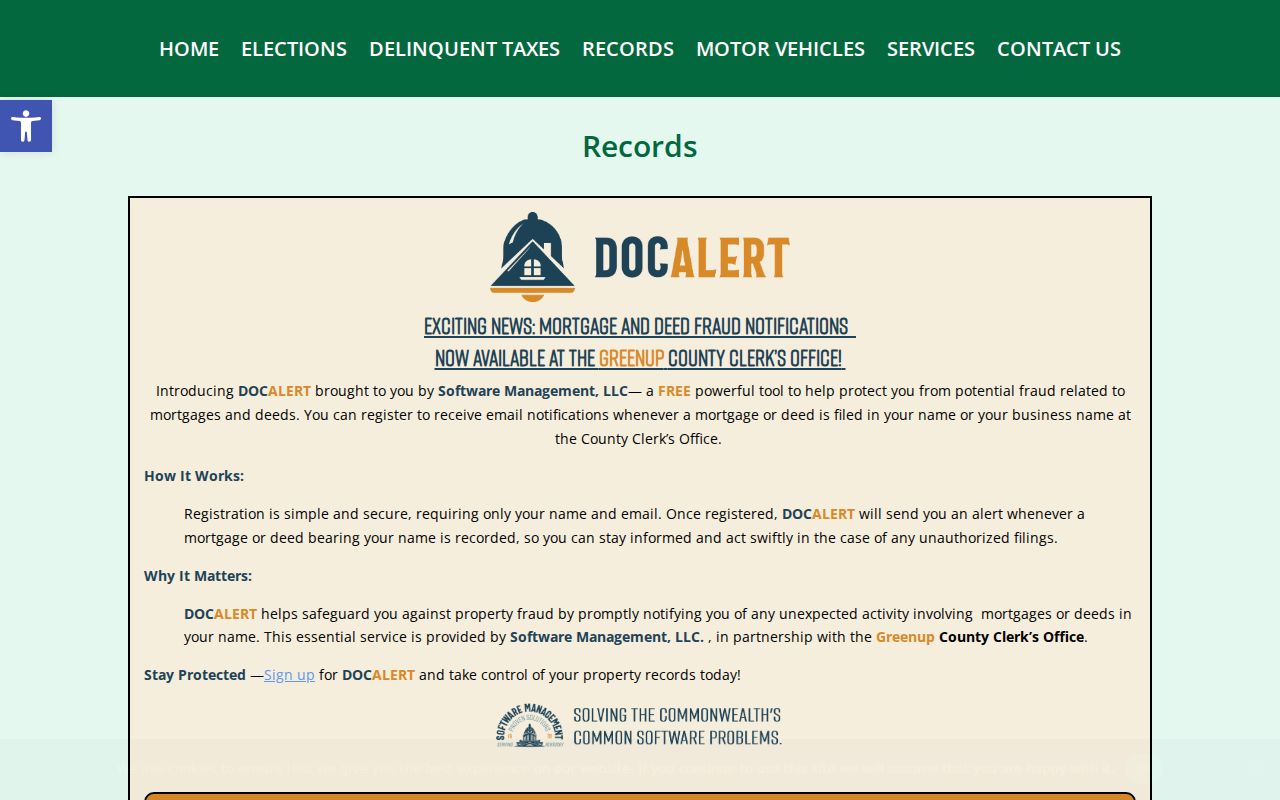
The same page also carries recording forms, office hours, and current access instructions worth checking before any document request.
Greenup PVA Record Limits
The PVA card sits at the heart of Greenup County property records. Its own disclaimer draws a careful line. Ownership, legal description, and valuation are believed accurate. Sale price, sale date, and property characteristics are not verified and may be wrong. The tax roll also uses a January 1 ownership date. So a deed recorded later in the year can outrun the tax owner of record shown until the next annual cycle.
The county PVA directory identifies Tony Quillen and links the qPublic property search. Kentucky property is revalued every year. A physical examination happens at least once every four years. Market movement, additions, fire, or other physical change can move the appraised figure. Remember that the PVA sets value, not the tax rate.
The official PVA page provides the county's handoff to its property search tools.
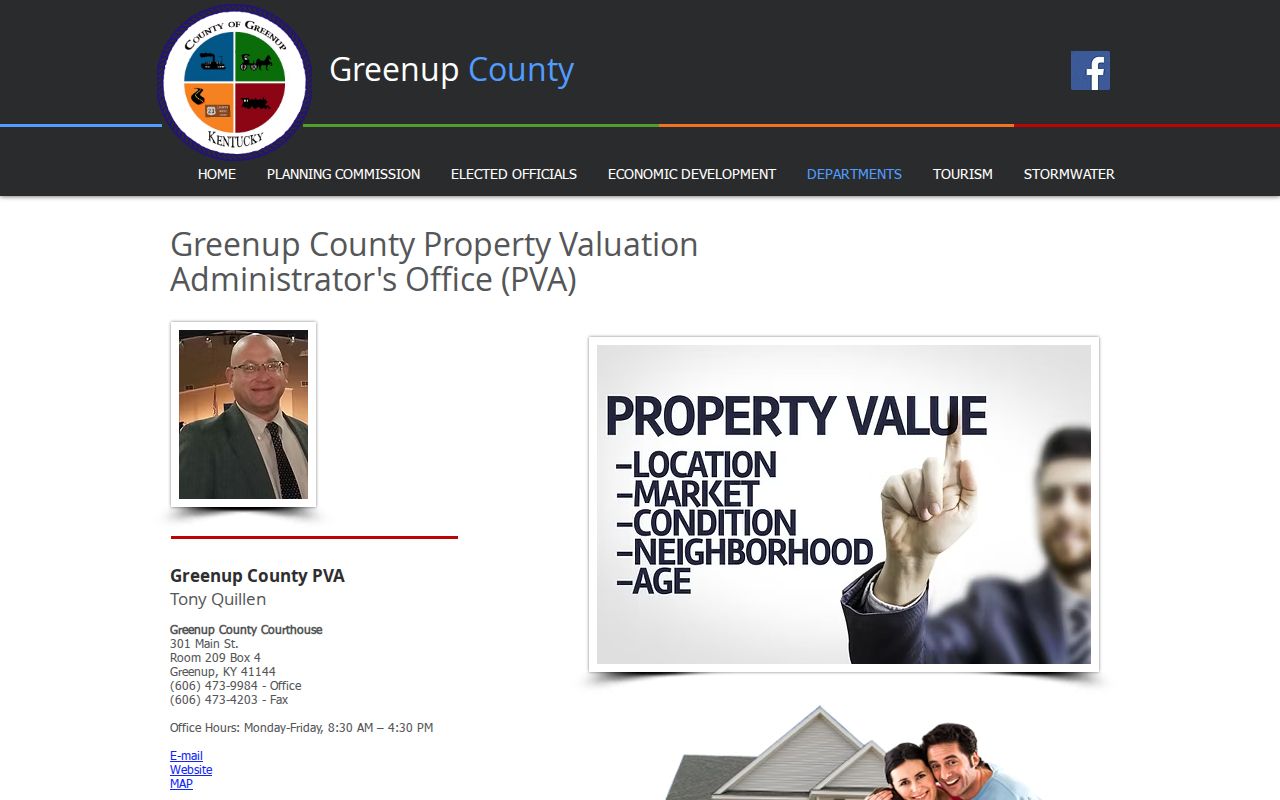
Call the office directly when the protected qPublic application blocks a parcel lookup.
Greenup Parcel Map Fallbacks
Greenup County publishes no separate public GIS viewer for parcel mapping. The qPublic application may show a parcel map, but only inside its protected side. For wider geographic context, turn to state sources. Kentucky GeoNet and the state's open-data services cover terrain and imagery across Kentucky. Treat those state sources as context, not as a county boundary authority. When a boundary matters, pull the recorded plat and the deed description. Then bring both to a surveyor.
A parcel is the unit the assessor values. It is tracked by its parcel number. A plat is different. It is a recorded drawing of lots, blocks, streets, and dedications. No screen-drawn parcel line or tax map substitutes for a boundary survey. That is why Greenup County property records research sometimes needs an office route rather than a live parcel layer.
The qPublic application is the official entry point. Its access screen shows what a visitor actually encounters.
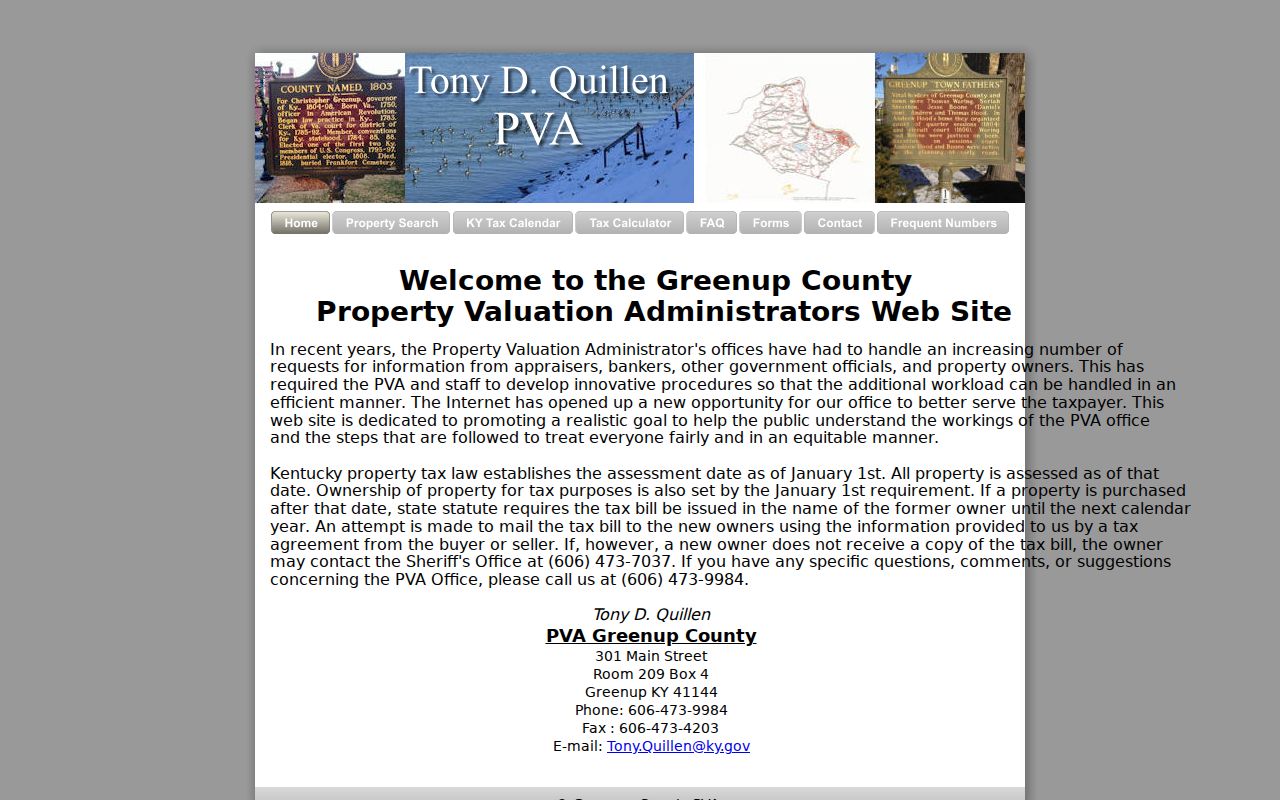
The image simply shows the available entry point. It does not promise that any specific map tool or result field is public.
Greenup County Property Record Types
Each Greenup County property record answers one kind of question. Need proof of a transfer? Start with the recorded deed. Want the current assessment? That lives on the PVA parcel card. A tax balance belongs to the Sheriff until a bill transfers, and then to the Clerk. Lot lines and legal descriptions come from the plat, while a disputed title event may sit in a court file. The table matches every record to its actual custodian and documented access route.
| Record Type | What It Documents | Kept By | Access |
|---|---|---|---|
| Deeds and easements | Transfers, rights, legal descriptions | County Clerk | eCCLIX, counter, written request |
| Mortgages and liens | Recorded claims and releases | County Clerk | eCCLIX and recorded books |
| Assessment and tax | Parcel value, exemptions, bills | PVA, Sheriff, then Clerk | qPublic, payment page, offices |
| Plats and parcels | Lot, block, subdivision, map context | Clerk, PVA, planning offices | Recorded plat, qPublic, request |
| Permits and zoning | Work, inspections, local land use | City or planning office | Forms, office inquiry, open-records request |
A parcel card can point to the latest deed, but it cannot stand in for one. Likewise, a deed names the land and the parties yet says nothing about a current tax bill. In Greenup County, the trail only comes together by matching names, parcel numbers, book and page references, and legal descriptions across these sources.
Greenup Taxes Change Custodians
For current bills, the Sheriff's property tax page is the collection route. The online payment form asks for a bill number and mailing address. Processor convenience fees apply. It is not a broad owner, address, or parcel-number search. April 15 is the last day to pay the Sheriff. After that, unpaid bills move to the County Clerk. Added charges and delinquent-tax procedures apply there.
The Sheriff's page also lists earlier-year links for 2015 through 2019. It does not publish a full public tax-search inventory. Take account problems and refunds straight to the office. A dated state schedule placed Greenup's 2025 tax sale on August 26, 2025. The Sheriff's tax page shows the narrow payment route a visitor will actually encounter.
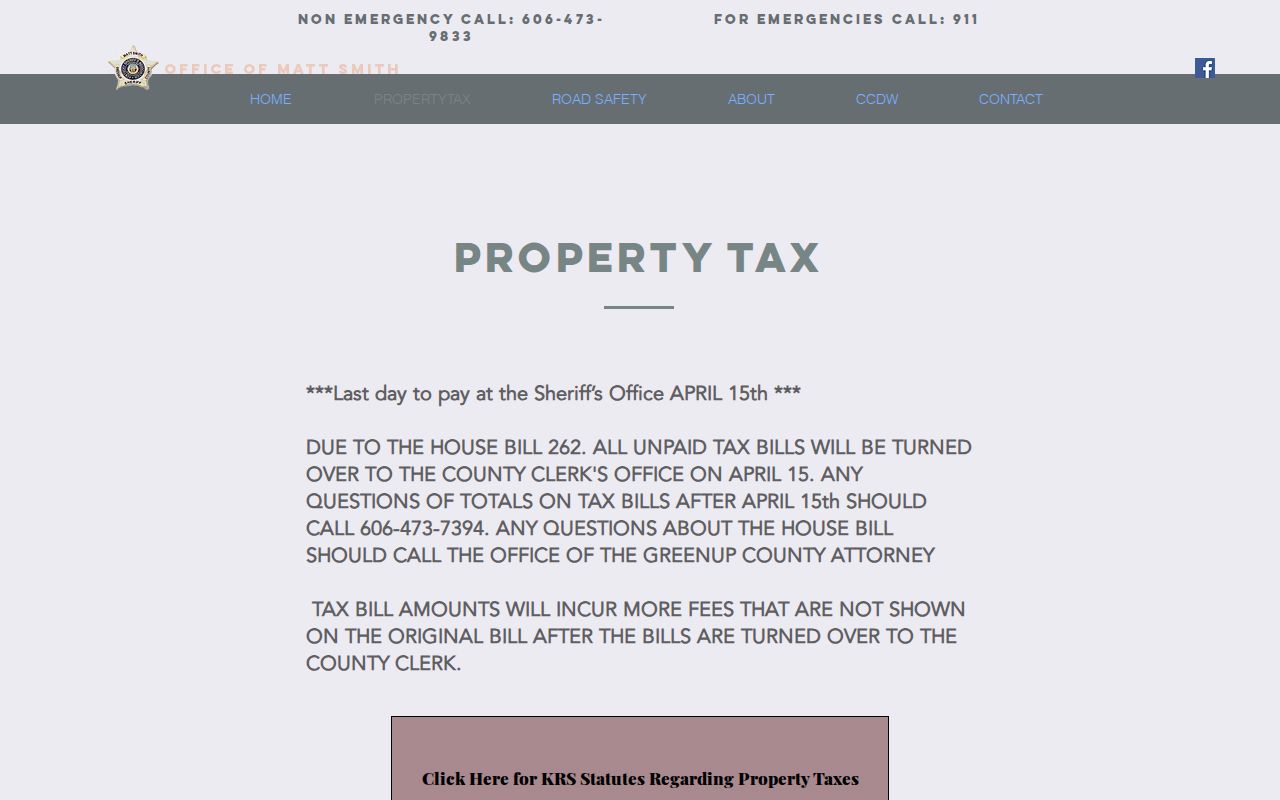
Write down the bill number first. Then call the correct custodian if the account has already transferred.
Subdivision Names Unlock Greenup Records
A subdivision name can open doors a street spelling cannot. Greenup notices tie Maplewood Addition to 2106 Riddle Street, parcel 183-10-10-074, and Deed Book 532 page 533. Highlandview Addition traces to Plat Book 4 page 9. Recurring names also include D&J Subdivision, Brenda Sue Subdivision, Wheeler Nickell Subdivision, Poplar Highlands, Riverside, Brookfield South, and Bellefonte Subdivision. Treat these notices as search seeds, not final proof. Copy the subdivision, lot, block, parcel number, and book-page clue into a request to the Clerk or PVA. Old descriptions often keep town-addition or industrial names long after street labels changed, which is why an address search should always be paired with the legal description.
Insider tip: Preserve APN punctuation and leading zeroes exactly. Normalizing a dotted Greenup parcel number can hide the match.
Older Greenup Land Records
Greenup County was formed in 1803 from Mason County, with county organization following in 1804. So a chain that predates Greenup may continue in Mason County materials. The Greenup County Public Library genealogy resources hold maps, local binders, cemetery tools, yearbooks, and in-house databases. They also link to "Old Kentucky Entries and Deeds." FamilySearch catalogs also describe Greenup wills and land-related materials. Access can depend on account or affiliate-library rules.
That fallback matters because the public eCCLIX index has no published cutoff year. Ask the Clerk where the online index ends. Then request deed books, reverse indexes, microfilm, or archive referrals for the earlier span. For Ohio River land, the library's regional maps can help. They cover Kentucky, Ohio, West Virginia, and Virginia. They can decode an old landmark or community name.
Note: A blank portal result marks an access limit. It stands until the Clerk confirms the searched years and books are online.
Greenup Court and Probate Trails
A title change is not always obvious from a deed list. Foreclosure, quiet-title, judgment, and probate events may explain it. The Greenup Circuit Clerk serves Circuit, Family, District, and Business Court records. This office sits at the Courthouse Annex. CourtNet offers statewide public case information. But the clerk remains the custodian for copies and older files.
Search a party name and a date span. Record the case number, type, filing date, parties, docket events, status, and any property description. Older cases may sit at a records facility. Others may have been destroyed under retention rules. The clerk can supply a facility name and locator number. Probate identifies an estate process. Yet title still deserves a check for a later deed, affidavit of descent, or other Clerk recording. The Kentucky Court of Justice county page lists the current court locations.
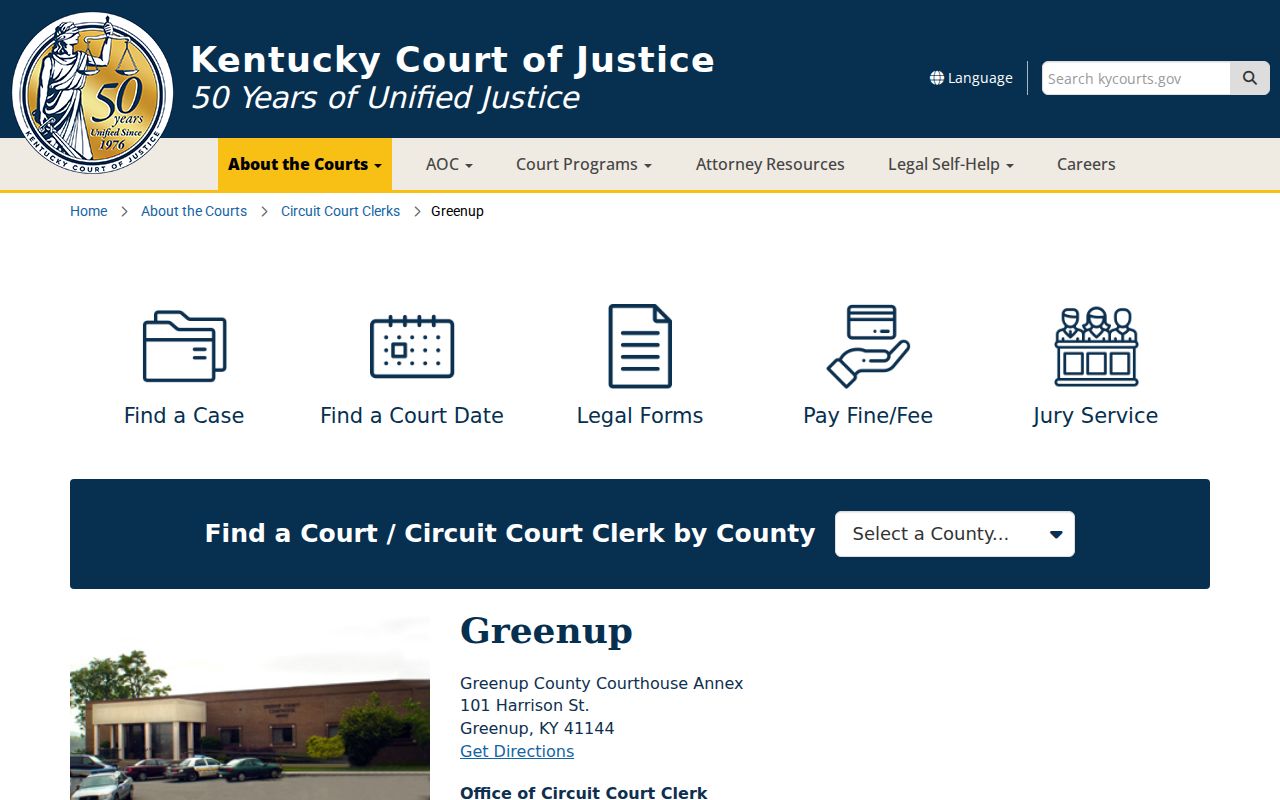
A new Greenup Judicial Center is under construction and is expected to affect future access. Verify the office before a later visit.
Greenup Records Request Channels
Online tools are one channel among several. The Clerk serves visitors at the courthouse counter and at Flatwoods and South Shore branches. Requests also come in by phone, by mail, through forms, and through a request to inspect records. The PVA offers an office, phone, fax, and email contact. The Sheriff resolves account issues in person. The Circuit Clerk can route older case files. City offices and the Joint Planning Commission may hold permit, zoning, annexation, and subdivision packets tied to a parcel.
The Kentucky Open Records Act, KRS 61.870 through 61.884, governs requests. A requester may submit a written, signed request. It should identify the requester and describe the records sought. Hand delivery, mail, fax, and email all work. The office must respond within five business days. Statutory exceptions and a stated delay apply if the records are not ready. Copy charges are limited to reasonable actual cost plus postage. Ten cents per paper page is the usual benchmark.
Ask for an existing record rather than a new analysis. Include the address, parcel number, parties, record type, and an approximate date range. Add the book-page or case number and your preferred format when you have them.
Greenup Deed Fraud Alerts
The Greenup County Clerk offers DOC ALERT through its records page. The service is free. It sends a notice whenever a deed or mortgage is recorded against a name you enroll. That name can be personal or business. Think of it as an early-warning system. It is not a watchdog over every instrument type. Never treat a notice as proof that a filing is valid. The enrollment page itself sits behind protection, so its full field list is not public.
Follow the Clerk's official link rather than a third-party alert page. If a notice lands in your inbox, write down the date. Also write down the filing clue it contains. Then call the Clerk. Ask for the index entry and the recorded image. Remember that an alert is no replacement for a title search, insurance, or your own review of the property records.
Key point. An alert tells you that a name match was recorded. The deed image and Clerk confirmation show what the filing says.
Limits of Greenup Property Records
Greenup County property records answer many questions well. They show the assessed owner, the recorded grantee, legal-description clues, tax value, exemptions, liens of record, subdivision references, and court activity. They cannot tell you who occupies a home. They cannot guarantee that every interest is indexed. They do not establish a surveyed boundary or say what a buyer should pay. Kentucky's Safe at Home program can mask an address in many government records. Real-estate holdings are expressly excluded from concealment.
Rely on official copies whenever the distinction matters. Bring qualified help for title questions. Use a licensed surveyor for boundary lines. Turn to the proper appraisal process for value. Public access to property records does not erase the duty to use personal data lawfully.
Lawful use. Greenup County property records support purchase research, title questions, boundary work, tax review, and civic oversight. Never use them to stalk, harass, or harm anyone.